La Crónica
The first records and the town's name
Before San José de Gracia had a parish, it had a room of adobe, a painting that faded, and a bell hung from a tree. Here is what the town's chronicle and the Tepatitlán archive record about its first chapel, its first parish entries and its name.
A room for the rosary, around 1815
The first chapel was a single room of adobe with a packed-earth roof. The chronicler writes that around 1815 one of the residents, after talking it over with his friends, built it so the rosary could be prayed there in the months without rain. Until then, Mass was said only now and then, in some suitable house. [per Rincón Alteño, pp. 30 to 31]
According to what people told him, an old woman who served in Antonio Rafael Hernández's first house set up a simple altar with a painting of the Holy Family from the main room of that house. She never knew whose it was. By about 1820 the painting had worn so badly that, after a carpenter repaired it, only the Christ Child and Saint Joseph could still be seen. Over time people began to call it simply "la capillita de San José." [per Rincón Alteño, p. 31]
Two stories for one name, and a different date
Antonio Rafael had his main-room door frame carved with Jesús María y Joseph and the year 1792, and the chronicler wonders whether the town's name came from it. [per Rincón Alteño, pp. 27 to 28] Later he leans toward that idea again. [per Rincón Alteño, p. 56] The two stories meet: the old woman of the chapel saw the painting's names carved on that same door frame. [per Rincón Alteño, p. 31] The carving is described on the Hernández family page.
Other sources give a different date. Since 2009 the Spanish-language Wikipedia article on the town has said the first chapel was built by 1822, citing the old sanjosedegracia.org site. The delegación's development plan (IMPLAN, 2021) repeats the same sentence. [per the IMPLAN plan, 2021, p. 29] Neither names a document. The book's 1815 is the chronicler's own dating.
A bell in an ash tree and a priest in residence
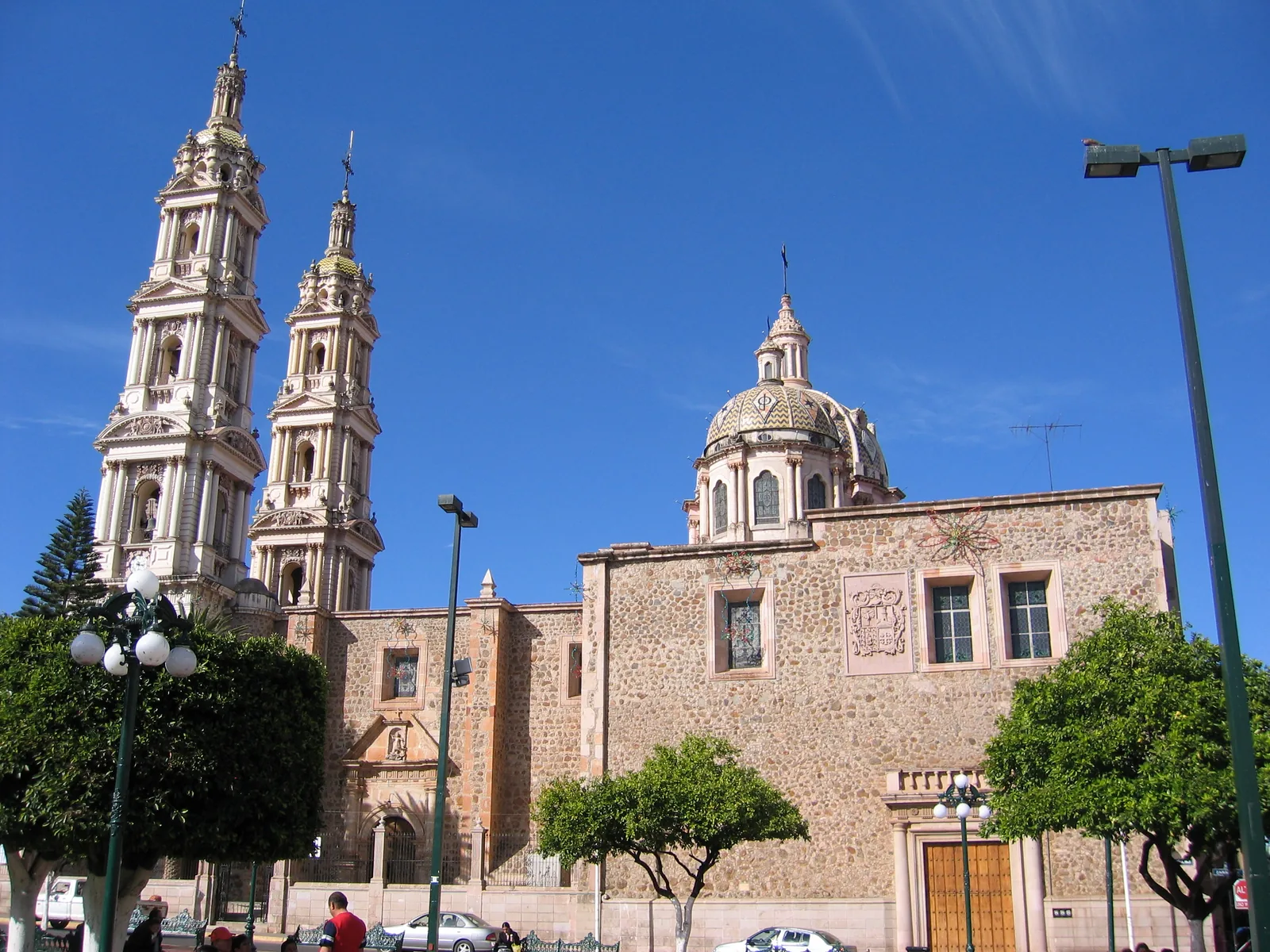
The chapel's big bell hung from an ash tree beside it. That bell, Santa María de Guadalupe, still rings in the left tower of the parish church. [per Rincón Alteño, p. 34]
The town had a resident priest by 1867, when, the chronicler writes, the old chapel was made a vicaría fija, a permanent vicariate of Tepatitlán's parish. He relies on a document lent to him by Tepatitlán's parish priest. [per Rincón Alteño, p. 18] The earliest priest he finds is Camilo Castellanos, in May 1867. [per Rincón Alteño, p. 33] A burial entry of 1878 shows him still serving. [per Rincón Alteño, pp. 18 to 19]
The first book of 1875: a baptism, a wedding, a cemetery
The town's parish books begin in 1875. The first entry of the first book, as the chronicler transcribed it, records that on 1 February 1875, at the Chapel of San José, Father Silvestre Barajas baptized Ildegunda, legitimate daughter of Manuel Arriaga and Filomena Hernández. Her godparents were Procopio and M. Felícitas Barajas. [per Rincón Alteño, p. 31]
On 3 February 1875 came the first marriage, of Timoteo Villaseñor, of Las Calabazas, and Juana Barajas, of El Aguacate. That month the chaplain obtained permission for a cemetery on the land next to his house, a few steps from the founder Francisco's. It opened on 14 February 1875. Until then the dead were carried to Tepatitlán. The first person buried there was Guillermo Becerra García, a six-year-old boy from Las Hormigas. [per Rincón Alteño, p. 32]
The book slips on one date: it narrates Ildegunda's birth on the evening of 30 January 1876, then transcribes the baptism of 1 February 1875. The record, the wedding and the cemetery all point to 1875, so 1876 looks like an error in the narration. [per Rincón Alteño, p. 31]
When "de Gracia" appears
In 1875 the place was called simply San José. [per Rincón Alteño, p. 32] The full name first appears in the books in March 1877, and the chronicler suggests "de Gracia" was added to tell it apart from other towns of the same name. [per Rincón Alteño, p. 33]
The Tepatitlán municipal archive has the name decades earlier. Its catalog lists an 1839 petition by Manuel Romanco to be restored to the land of Santa Rosa, marked "(Sn. José de Gracia)." [per the Tepatitlán archive catalog, Caja 19-II, Exp. 1, 11 August 1839] In 1845 the estate file of Don Antonio Rafael Hernández is described as "en la Hacienda de Sn José de Gracia." [per the Tepatitlán archive catalog, Caja 27-I, Exp. 44] Two 1857 files list an inspection of the road to La Soledad, "los vecinos de San José de Gracia" at a spot called La Laja, and a request by Tiburcio Casillas about opening a road. [per the Tepatitlán archive catalog, Caja 43, Exp. 7 and Exp. 13] These are catalog summaries, but they suggest the name was in civil use long before 1877.
The catalog also places the family. A book of orders dated 20 February 1827 belongs to José Antonio Garmiño, Cuartel 17. [per the Tepatitlán archive catalog, Caja 8-II, Exp. 24] On 29 March 1827 José Antonio Hernández Garmiño appears as comisario of Cuartel 17. [per the Tepatitlán archive catalog, Caja 8-II, Exp. 31] A 1829 book is titled for the Rancho de la Soledad, Cuartel 17, with Encarnación Hernández as comisario. [per the Tepatitlán archive catalog, Caja 10-I, Exp. 38] In 1831 the goods of the late Don Francisco Hernández Garmiño were inventoried. [per the Tepatitlán archive catalog, Caja 11, Exp. 24] Francisco and José Antonio are the names of two founders, and one branch of the family was known as the Hernández "Gamiños." [per Rincón Alteño, p. 13] The catalog does not say whether these are the same men.

Comisarios chosen under the portal, then delegados
Once there were enough houses, Tepatitlán began naming comisarios. [per Rincón Alteño, p. 30] Among the early ones the chronicler names Antonio Hernández, Regino Rubio, Ramón Álvarez and Encarnación Hernández. [per Rincón Alteño, pp. 37 to 38]
A resident described the election to him. The scribe Vicente Sánchez sat under the portal, and each citizen marked a short line on the paper next to his candidate's name. The sheet was nailed to the wall, the votes were counted in public and Tepatitlán confirmed the winner. Nobody wanted the job, because the comisario was authority, policeman, jailer and town crier at once. [per Rincón Alteño, p. 38]
The development plan dates the formal change. After the 1917 Constitution the town was a Comisaría Política of Tepatitlán, and in 1939 Tepatitlán's council named its first delegado. [per the IMPLAN plan, 2021, p. 29] The book lists the delegados who followed, from Emilio Ferreira on, and dates some of their work, such as José Auxilio Arriaga's road in 1967 and Filemón Arriaga's request for telephone service in February 1968. [per Rincón Alteño, p. 38]
The book uses the title earlier. It calls J. Trinidad Báez the delegado municipal when he was killed on 19 September 1935, on the old lane toward San Antonio behind the house of Chuy Martínez. [per Rincón Alteño, p. 17] The sources do not say whether the title was already in use before 1939.
1934: the town that almost became Villa Hernández
On 20 December 1934, Tepatitlán's town council asked the state congress to rename the Comisaría Municipal of San José de Gracia as Villa Hernández, "in memory of the founders." The letter, signed by municipal president José María Arias and secretary Arturo Peña Aceves, says the council was seconding an initiative of the legislature itself. [per Rincón Alteño, p. 19]
The change was never made. The chronicler kept a photostat of the letter, as a reminder of the danger. In his view, so soon after the Cristero war, some in Tepatitlán wanted to win favor with the government, and the congress ignored them. [per Rincón Alteño, p. 19]
Sources
- Taurino Arámbula Vázquez, Rincón Alteño (1974; text corrected June 1993): the first chapel, the 1875 parish entries, the 1877 name, the comisarios, the 1934 Villa Hernández petition (pp. 13, 17 to 19, 27 to 28, 30 to 34, 37 to 38, 56) [local tradition]
- Archivo Histórico Municipal de Tepatitlán, Catálogo de Documentos Históricos: Caja 19-II Exp. 1 (1839); Caja 8-II Exp. 24 and 31 (1827); Caja 10-I Exp. 38 (1829); Caja 11 Exp. 24 (1831); Caja 27-I Exp. 44 (1845); Caja 43 Exp. 7 and 13 (1857) [primary]
- IMPLAN Tepatitlán, Plan de Desarrollo de la Delegación de San José de Gracia (2021), Antecedentes, p. 29 [secondary]
- Wikipedia (Spanish): San José de Gracia (Jalisco), the 1822 chapel sentence, present since 26 October 2009 [secondary]