La Crónica
Trades of the old town
Before the roads and the tequila, San José de Gracia pressed its own linseed oil, tanned its own hides and made its own shoes, soap and cheese. This is what the town chronicle remembers about how people earned their living, and who did the work.
The fields came first: maize, linseed and agave
The town began as farmland. When the four Hernández Padilla brothers divided El Bramido, sharecroppers (medieros) soon followed, and with them came carpenters, blacksmiths, masons and the other workers a new settlement needed. The chronicler sums it up simply: they had the people and the trades to get by on these plains. [per Rincón Alteño, pp. 25-26]
The book lists what the red soil gave. It gave lemons, oranges, walnuts, guavas, limes, peaches, pears, prickly pears and other fruit, along with maize, linseed (linaza), wheat and beans. The tequila agave did well here too, and people simply called it el mezcal. [per Rincón Alteño, pp. 20, 23]
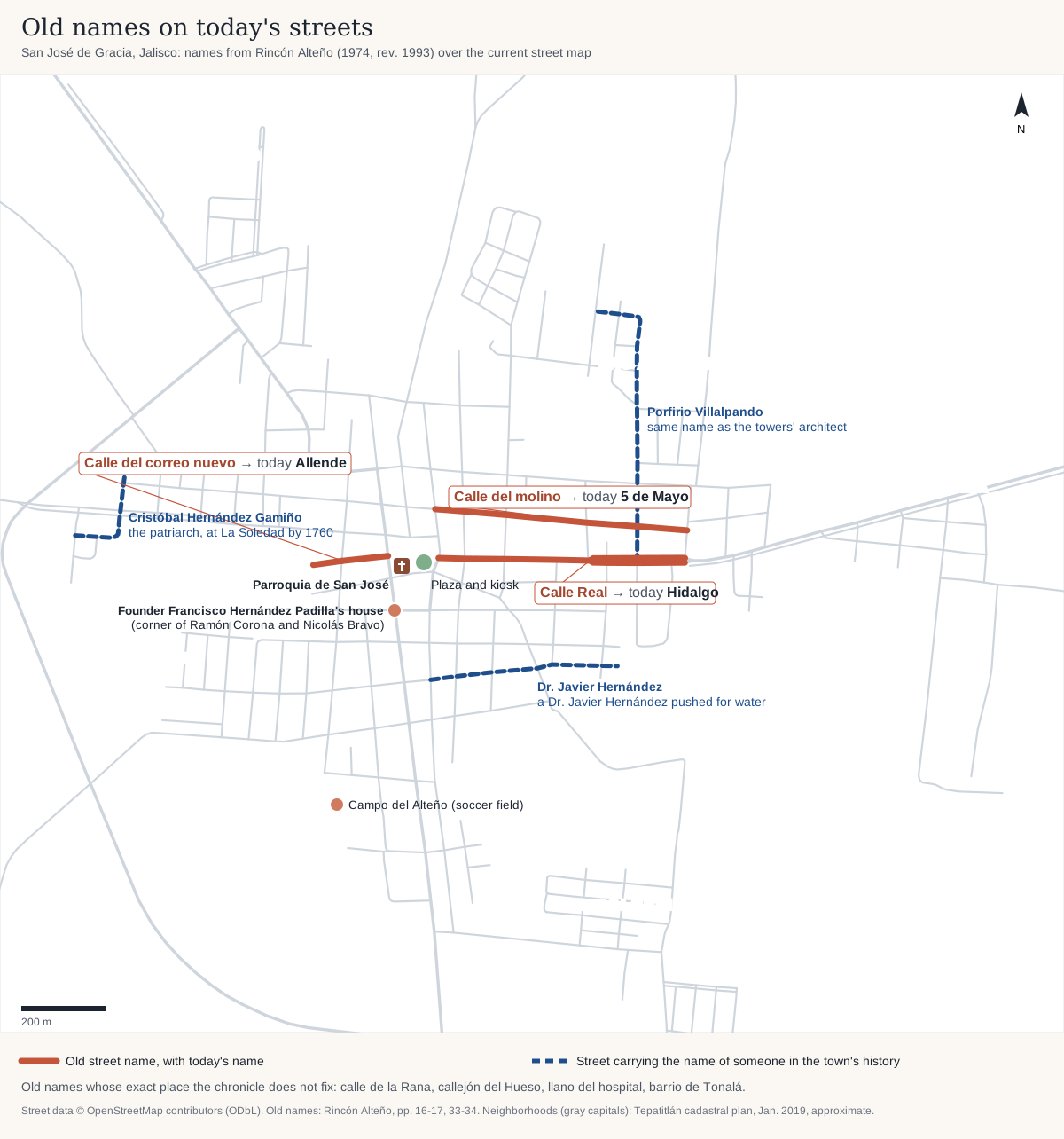
Grain grew inside what is now the town. The chronicler recalls wheat sown in 1932 on a block of the calle Real, today calle Hidalgo. He also heard that wheat was once grown toward where the nuns' house now stands, with guava trees in between. [per Rincón Alteño, pp. 17, 33]
In his chronicle he counted the town's means of living as farming, cattle and the agave, plus one more that every Altos family knew: the trips to the United States. [per Rincón Alteño, p. 23]
Four linseed mills and the road to Colima
So much linseed was planted that the town needed mills to press it. One mill opened, then more, and all of them had work. By the early twentieth century there were four:
- Don Antonio Hernández, on calle 5 de Mayo, where a ruined shed stood in 1993. It was the last one working, and older people still remembered its small whistle that marked the change of workers at 2 and at 14 hours.
- Pedro Álvarez, in the barrio of Tonalá, a little past the stone mound near the lane that comes down from the hill.
- Don Valente Hernández, at the end of the second block of calle Pedro Moreno.
- Don Cristóbal Hernández, at the start of the second block of calle Real, on the right-hand side.
The book also calls 5 de Mayo by an older name, the calle del molino. [per Rincón Alteño, pp. 17, 34]
The oil traveled far. It was carried in cans like the ones used for alcohol, loaded on mules and donkeys, to Mexico City and Guadalajara, and as far as Colima. On the way back the animals brought mostly salt, along with other goods bought in the larger towns along the road. [per Rincón Alteño, p. 35]
Tanneries, shoemakers, soap and noodles
The mills were not the only industry. The town made pottery and soap, and it had three tanneries: one belonging to Don Salomé Angulo, one to Braulio Barboza, and others in the last block of calle Aldama, on the right-hand side. The chronicler names good carpenters as well: Clemente, Sixto, Martín and Amado Becerra. [per Rincón Alteño, p. 34]
Shoes were made here too, enough for what the town needed. Antonio Hernández made them in the last house of the second block of calle Real. Don Martín, known as Martín zapatero, worked in his shop by day and sold sweets he made himself by night. His little bottles of wine were famous, though someone told the chronicler the wine was only in the name. The last shoemaker an elder could remember was the maestro Severo Hernández, who made two-strap shoes and elastic-sided boots on calle 5 de Mayo. [per Rincón Alteño, pp. 34-35]
Later came a noodle factory, run by Don Trino Ruiz, and a second soap factory, run by Don Juan Rubio. [per Rincón Alteño, p. 35]
By 1888 there were already shops and portales, at least on the north side of the plaza. The chronicler adds that the old stores carried everything, more than in his own day. When he complained about this in 1993, an old woman told him: "You should have lived back then." [per Rincón Alteño, pp. 34-35]
Cheese for three markets, lemonade with a hook
The house of the founder Francisco, the first house in town, later passed to other owners. One of them kept many cows there, and their milk became a well-known cheese. It went out on donkeys and mules to be sold in Atotonilco, Ocotlán and Guadalajara. The owner also had a house in Arandas and split his time between the two, leaving a caretaker to keep the house clean, look after the cheesemaking and air the room. [per Rincón Alteño, pp. 25-26]
Don Cenovio Hernández set up a lemonade factory in town before the Cristero war. Later he had to move it to Atotonilco. The chronicler still knew the product: the famous limonadas de gancho, opened with a sharp slap of the open hand. They were sold in town and in the surrounding area, back when people had to travel to Ocotlán to catch the train because Atotonilco did not yet have one. [per Rincón Alteño, p. 37]
A legend: the beam full of gold
The cheese house has a story attached to it, and the chronicler tells it the way it was told to him. One morning the caretaker found a hole in the roof of the big room. Thieves had broken through at night and taken six wheels of cheese. He climbed up to patch the hole with brick and mud, and noticed that the beam under it was hollowed out along its top. The more mud he packed in, the more it took. When he pulled away more bricks, he saw the whole beam was filled with gold coins (onzas de oro). [per Rincón Alteño, p. 26]
He rode to Arandas to tell the owner, who came, took the money down and, people say, handed the finder a single coin with the words "go buy yourself a Chavinda rope." The other beams and part of the walls were later taken down in hopes of more, but no other hollow beam was ever found. The chronicler explains it by the times: there were no banks nearby and no safe place to keep money. [per Rincón Alteño, pp. 26-27]
This is oral tradition. The book mentions it twice, both times in the founder Francisco's house. Once it is a passing note dated around 1900. The other time it is the full story above, where the owner lives part of the year in Arandas. That owner does not fit the chain of heirs the chronicler gives for the house in the same years, so the details should be read as legend. [per Rincón Alteño, pp. 11, 26]
The tithe corn and the 1956 explosion
Part of every harvest went to the Church as a tithe, and the town kept that maize in storage. The chronicler remembers an old house near the road out to Atotonilco used for it, and by 1956 it was kept half a block behind the church on calle Allende. [per Rincón Alteño, pp. 16, 68]
On the afternoon of 30 June 1956, while preparing to fumigate the tithe maize, Don Valeriano, father of the parish priest Juan Hernández, lit a cigarette, which set off a fire and an explosion. He and two other men, the carpenter Salvador Ruiz and J. Santos de Chepa, were pulled from the rubble alive but burned, and Don Valeriano died in Guadalajara in early July. [per Rincón Alteño, pp. 68-69]
When the work went north, and what carries on
By 1993 the chronicler saw the old balance changing. Men kept leaving for the United States because, as he saw it, farming paid too little, fields suitable for planting were left unsown, and what was planted was almost all maize, since beans had nearly stopped being grown. He worried that the region would end up planted entirely in agave, with tequila to sell and little left to eat. [per Rincón Alteño, pp. 20-21]
He also counted the trips north as a real source of income for the town, since many paisanos settled for good in the United States. At the May fiesta, the pilgrimage of the absent (la peregrinación de los ausentes) was growing every year. [per Rincón Alteño, pp. 23, 74] The longer story of that migration is told in The Diaspora of San José de Gracia.
Some of the town's work goes on in new forms. The agave he worried about now feeds the Tequila Hacienda Capellanía distillery, on the old La Capellanía hacienda lands (see La Crónica). Cremería Macías sells the town's longaniza by the meter, and the bars around the centro still pour coquitas, the cola and cane alcohol shot of the Altos. The linseed mills, the tanneries and the mule trains to Colima survive only in the chronicler's pages and in a street people once called the calle del molino.
In town today
- Cremería Macías Still selling the town's longaniza by the meter.
- Tequila Hacienda Capellanía The tequila made today on La Capellanía land.
Sources
- Taurino Arámbula Vázquez, Rincón Alteño (1974; text corrected June 1993): crops, the linseed mills and mule trains, tanneries and shoemakers, the cheese house and the gold-beam legend, the lemonade factory, the 1956 explosion (pp. 11, 16-17, 20-21, 23, 25-27, 33-35, 37, 68-69, 74) [local tradition]
- La Crónica de San José de Gracia: Land & work (Tequila Hacienda Capellanía on the La Capellanía lands) [secondary]
- Coquitas: the cola-and-cane shot of San José de Gracia [secondary]
- Longaniza por metro: San José de Gracia's sausage by the meter [secondary]